Tag Archives: eric dunstan

What Can Bank Social CRM Teams Learn from Ford? A lot!

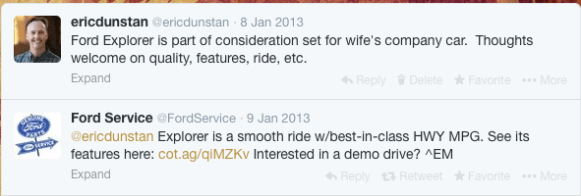
Last year my wife and I began our search process to find a new SUV. Our consideration set included Toyota, Ford and Chevrolet. I tweeted out one evening that we were considering the Ford Explorer and asked for feedback from my community.  Within 24 hours I received a reply…not only from friends, but also from Ford.  The response included a link to the Explorer’s features and an offer to schedule a test drive. Color me impressed. (Tweet me at @ericdunstan with the 80s movie reference)
Image

I responded that we were interested in a test drive. A Ford rep quickly responded and offered to schedule a demo and to provide incentives.

Image

Ford is effectively using social media as a lead generation tool and quickly acquired my information to schedule a test drive.  I used all natural language text with no # or handles. Clearly Ford is monitoring the social media channels and has an effective strategy to capture the information and act on it.   Nice work.

I recently blogged about my frustration with the mobile deposit feature of the Wells Fargo mobile application.  I tweeted my frustration as part of a theraputic venting processes.  Within 24 hours Wells Fargo replied with a tip to address the mobile application #fail and a request for me to call a 1-800 number to address any further issues.

Image

I applaud Well Fargo for capturing or “hearing” my frustration on Twitter and responding.  However, given the importance of social media as a marketing channel, Wells Fargo’s response is almost a given.  I would imagine that almost all of the Top 100 banks have similar processes in place to monitor and manage the social media channel.  However, I believe Wells Fargo’s response falls short of meeting my customer needs and their social media team could learn a lot from what Ford is doing.

The Wells response was very generic and made me do the heavy lifting.  “Try closing the app and restarting your phone.  If the problem persists, please call 800….”  Duh. Wells Fargo, I’ve been an iPhone user sense the iPhone 3 and know that restarting an app is a quick fix.  However, given the Wells app recent reviews, I think this functionality fail is an application problem.  Additionally, the LAST thing I want to do is call your 800 number to then have to dial through a myriad of prompts to eventually talk with a representative after a several minute wait.

The Ford response was very personal, responded to my specific question, and provided a channel to connect with a representative directly.  Ford made me feel personally taken care of, listened to and treated as a desired customer.  Wells could have worked harder by…

1. Offering to collect my information so an online/mobile customer service rep could contact me directly

2. Having the rep present the option of contacting him or her directly through a Twitter DM to help trouble shoot

3. Providing me a link to their website with a list of known issues

4. Acknowledging my frustration and offering an incentive as a “mea culpa” for their failed application

I feel like my concerns were heard by Wells Fargo, but I don’t feel personally taken care of to ensure my issue was resolved and that I’m a valued customer.  This is an example of the difference between just listening to the customer and engaging with the customer.  By engaging with the customer, Wells has the opportunity to personally respond to my need to show that my customer relationship is valued.  Ford did this so well that we bought an Explorer from them.

Moving beyond just listening to and engaging with the customer may require rethinking how customer support teams are trained and incentivized.  Additionally, companies should consider implementing a social media analytics and engagement software solution.  These solutions go beyond functionality of Tweet Deck that enable users to track multiple accounts and listen for mentions of their company or brand.  The more robust solutions, like Attensity or Nimble, for example, enable companies to listen to the customer, analyze the need and then act on meeting the customer need.

Consumers are increasingly frustrated with their banking relationship. There are a few Internet and mobile only banks, like GoBank or Moven, which take the mobile experience and customer service seriously.  Leading banks, including Wells Fargo, will quickly lose customers should they not learn how to actively engaged with their customers through all channels of customer support, including social media.


Know your customer first to find the right strategic partnerships

This week I had a conversation with an executive at a mobile banking company. We spent a majority of our time discussing the strategy of using strategic partnerships to build a customer base, deliver products that meet customer needs and generate revenue. This executive shared an unfortunate experience where his team was pushed into a partnership where they provided most of the product development resources and had to commit to the lion share of the marketing spend to promote.  Unfortunately, the double barrel commitment yielded little return in helping the company achieve its goals. The partnership was more of a distraction and had high opportunity costs. Frustrating.

Strategic partnerships are an important lever to pull to grow revenue, drive acquisition, build out technology, and increase product functionality.  However, it’s mission critical that the right strategic partnerships be established or the relationships will be a distraction and take critical focus off of what is important.

One of the most important exercises a company must go through is to understand who their customer is and how the company will meet customer needs.  Without this understanding, it will be impossible to find the right strategic partnerships. Once the customer is understood, companies need to evaluate potential partners across 4 factors.

The first factor is access to the right customer.  Will the partner enable a company to market their product to a customer segment that will generate revenue and have high life time value?  If not, the partnership will yield access to consumers whose needs are not met.  As a result, little value will be provided to the company.  Unfortunately this happens far to often as young companies rush to find ways to acquire new users and monetize as quickly as possible.  As we all know, this is a symptom of a short-term focus and a need to show growth to current and would be investors.

The second factor is to understand the required investment needed to realize the value of the strategic partnership.  For example, eBay entered into a strategic partnership with PayPal to meet the needs of its users to pay for things securely online.  Yes, eBay had to invest product resources to integrate the PayPal technology into its listings.  However, the investment had a very positive ROI for it brought huge value to eBay buyers and sellers. The product partnership proved to be very successful, as we know, and eventually resulted in eBay acquiring PayPal.

The third factor is the company’s internal resources and willingness to support the partnership.  I’ve seen many companies stumble on this factor. I was part of an organization that needed to partner to quickly provide product features to remain competitive.  It was one of those standard “make vs buy” debates that resulted in the executive team deciding to move forward with a partnerships strategy.  Unfortunately, employees outside of the executive committee did not feel they had the resources needed to support any technology partnerships and quickly dug their heals in and resisted any discussions. Needless to say, any partnership agreements quickly stalled in the implementation process.

The last factor is both parties’ shared interest in a successful outcome.  The partnership must be of equal or greater strategic importance to both partners.  While at Excite@Home I managed a strategic partnership with Paramount Pictures that was designed to increase awareness that Excite was a destination to learn more about the latest blockbuster movies. I managed a team of developers, designers and marketers to build solutions to promote Paramount’s movies across the Excite@Home network.   We busted our butts to get things done.  Unfortunately, Paramount didn’t have much interest in promoting us as defined in our partnership agreement.  We were lucky to get an Excite@Home logo placement on the front page of the Paramount website…but were nowhere close to receiving any offline placements.  Paramount reminded us of this too frequently.  Such is life in the big city. It will always be Silicon Valley vs Hollywood.

So blah.  What is the conclusion to my bloviation? Before company executives start frothing at the mouth to strike strategic partnerships, it’s important to do the introspective work first.  Who is your customer?  What customer needs are being met with the product?  What needs are not being addressed by the product?  Only with this sense of corporate self-awareness can companies enter into fruitful strategic partnerships.  Without doing the upfront work first, it’s like searching for a spouse without knowing what qualities one is looking for in a mate.


Mobile must remain a priority for large banks to retain customers

My family and I received several checks from family members as gifts and as payback for gifts purchased.  My wife typically handles the day-to-day checking account and generally handles making deposits at the nearest Wells Fargo ATM.  I suggested that she try using the mobile deposit feature on the Wells Fargo mobile application.  Being the wife of someone who works in FinTech, she agreed to try out the feature….despite all the negative feedback about the application. Unfortunately,  she successfully validated the negative comments splattered across iTunes.

The biggest disappointment came through the application crashing after each attempt to deposit a check using the mobile deposit feature. What I found most interesting were my wife’s comments after the 3rd attempt. “Well, Wells Fargo, I guess you REALLY don’t want me to use this feature,” was the first comment.  The second comment was “What happened to the pics of the checks I took before the app crashed? Are they stuck in the app or are they with Wells?  Can someone steal the money?”

Three interesting thoughts came to mind as I digested her valid complains.  One, when it comes to getting customers to try new features that involve their money, banks better be sure the feature works for the customer the first time.  Yes, app crashes can happen for many reasons.  Unfortunately, several reviews reflected the same frustration and experience my wife had…which implies that improvements need to be made to the application. From my wife’s point of view, Wells Fargo implicitly told her mobile deposit is not ready for prime time and to keep using the ATM.  Wells needs to track that these customers are and target them with a “mea culpa” CRM program to win back their trust with new technology. After all, according to a recent study, 49% of consumers will change banks for a better mobile experience.

Secondly, I think my wife’s concerns about where the check pictures have gone after the application crashes point to an engrained reaction that stems from frequent e-commerce transactions.  I think similar “where’s my money now?” concerns come up when a consumer enters in a credit card number online, presses submit and the site crashes. “Did my credit card go through? Do I need to re-enter my credit card? If I do, will I get double charged?  Is my card number safe?”  All are common questions following an e-commerce site crash.  I think it’s only natural for my wife to ask similar questions after a mobile banking application fails.  In-application messaging must be delivered immediately to consumers to quell their anxiety when things don’t go as planned.

Lastly, the low application star rating and poor review indicate that mobile is NOT a big priority for Wells Fargo. In an effort to win customers, I would imagine that the mobile team would quickly iterate and redeploy an application as quickly as possible. Unfortunately, Wells Fargo is not the only major bank that appears less focused on winning customers through mobile.  Chase and Bank of America have similarly low rated mobile applications. If these major banks do not step up their focus on mobile, the door will remain WIDE OPEN for innovative mobile banks like GoBank and Simple to entice customers through compelling mobile banking experiences.


Mobile platform security is key for mobile payments providers

I was at one of many Christmas parties and conversation topics, of course, covered “where will you be for Christmas” and “are you done with your shopping.”  Almost everyone was done with their shopping, but the big follow up question was “Well, did you end up shopping at Target?” There were a handful of people at this gathering that did shop at Target over the ill-fated shopping period.

The conversation very quickly involved everyone around the buffet table and included comments like, “I can’t believe hackers actually were able to break into a huge chain like Target” and “your credit card information is not safe anywhere!” Clearly EVERYONE at this party will be checking their credit card statements very closely in January!

However, one comment made really grabbed me. “If my credit card can be swiped by hackers at Target, I’m sure as hell not going to want to use my phone to pay for stuff.”  Obviously this exclamation sparked another round of fervent debate and discourse. A few well-known coffee and pastry shops in the area were called out in conversation as using new mobile payments technologies and were “flagged” as potential places to monitor for card fraud.

The implications of the Target data breach on the mobile payments vertical are HUGE.  There are serious challenges that must be addressed both on the consumer and business side of the equation for the many emerging mobile payments technology providers.

First of all, consumers have the perception that it’s no longer safe to use even debit or credit cards at physical retail stores.  According to one account of the Target breach, a security analyst at a major bank was made aware that cybercriminals were planning to sell online a new stock of stolen credit/debit cards.  The analyst bought the stolen card numbers of his/her bank customers using Bitcoin.  Presumably, these transactions lead to the discovery that these card numbers were stolen from Target.

One could easily make the assumption that Target was not even aware of the breach until the bank analyst made these card number purchases from the cybercriminals. Yikes! This lack of awareness of the problem scares me deeply at the consumer level.  Would Square be able to quickly inform a merchant that consumer’s payment data has been swiped and is being sold by cybercriminals? Could Square inform users that their data was stolen?

Secondly, business and IT executives at Target and all major retailers are wondering how and why the Target payments system was hacked.  Obviously, there are fast and furious internal investigations within Target as their legal and technical teams prepare for a barrage of lawsuits coming their way from banks and consumers.  These Target executives will be pounding on the doors of their payment system providers and their 3rd party vendors as well.

The discovery phase of these lawsuits will get UGLY FAST.  Moving forward post breach, all physical and online retail payment platform providers will be evaluated with much greater scrutiny with a focus on platform security, ability to detect a data breach and processes to quickly inform users that data has been compromised.

Emerging payment providers such as Square, Dwolla and PayPal need to address these implications head-on to address consumer and business needs in a post Target data breach world.

Platform security is now a big focus.  Yes, each provider does have website messaging that talks to how secure their platform is.  However, security requirements and technology must be increased especially as the payments platforms are being sold into individual SMBs and at the enterprise level that use multiple mobile devices to process transactions.

Mobile payment providers can quickly equip themselves with cutting edge mobile platform security technology through strategic partnerships.  Industry leaders include MobileIron, Good Technology, or AirWatch.  For example, by partnering with MobileIron, Square can provide a layer of mobile platform security to their SMB customers who use the payment platform across multiple mobile devices (payment terminals).

Addressing the mobile platform security needs will help address consumer concerns as well that their payment data and money are safe at the payment platform level. Square, Dwolla and PayPal must educate consumers on WHY their payment data and money are safe.  Providers must clearly explain what happens if a Square account is hacked and the PIN number and cash balance is stolen.  Can these providers stand behind a guarantee that transactions are safe?  Can they back up consumers’ cash balances if the money is stolen?  These are all key concerns that must be addressed for consumers to feel safe in using mobile payments technology to pay for items at physical retail.

Personally, I keep a very low balance in my mobile PayPal account that is connected to a low balance bank account.  Why?  I still don’t trust that the receiving terminal is that secure and nefarious code could somehow steal my account numbers and distribute across the world…all through an unsecured wireless connection at the SMB’s business location.  Maybe I’m just paranoid and uneducated.


Square is proving to be a valuable alternative payment solution for small businesses

This past weekend I had a great conversation with a friend of mine about wine, politics, classic cars and payment technology.  As the song goes, “these are a few of my favorite things.”  My friend, Mick, is an auto mechanic based out of Monterey, CA who focuses primarily on British and other European import cars.  When I say British, I mean early 1970 Mini Coopers before BMW started importing the more stylized versions with nifty customized paint jobs and stripes. He’s a British car enthusiast’s enthusiast…with the accent and Rolling Stones t-shirt to boot.

Mick is a savvy business guy and has A LOT to say about small business banking, lending, payments processing and taxation.  After a few mimosas the conversation gets very lively as you can well imagine.

I learned that Mick currently uses the payment processing tools, software and equipment provided by his business bank, Rabobank.  The bank makes it easy for his business to use their credit card processing machines through favorable card processing fees, equipment leasing options and bundled low interest loans and credit cards.   Rabobank typically charges him 2 ½% – 3% on processing fees for Visa and MasterCard transactions only.  The bank also has account managers available to help with any problems in the payments processed…and are constantly trying to cross sell him into other bank products.

Last month Mick started to explore alternative payment processing options out of frustration with the Rabo solution.  Rabobank processes payments only in his shop using Rabo supplied machines.  Unfortunately, his checking account does not receive the payment until 3-5 business days after the credit card transaction is made.  These machines are a bit clunky and keep him tied to his shop which is a problem for he deals with many customers at other garages. The solution also does not connect to his inventory management solution so he has to track each sale separately on his supplier order forms.

A friend suggested that he look into Square.  His eyes got wider as he described all the great features Square has to offer through a FREE downloadable app and simple card reader connected to his iPad. Yes, the wide eyes could have been due to the mimosas, but his excitement was palpable.

“Through Square I can now load and access all of my parts inventory and process orders from anywhere.  I met a guy at a coffee shop last week and he ordered several Jaguar parts from me.  I punched in the order on my iPad, ran his credit card and emailed him the receipt. I gave him the parts and it was done.  Amazing.”

Mick was also excited about the 2.75% transaction fee, no equipment rentals and the ability to access Visa, Mastercard, Discover and AMEX.  The excitement around the mix of credit cards surprised me.  However, his clients are typically high-end car collectors.  AMEX is this customer segment’s card of choice….which is a point of differentiation for Mick’s shop compared to others in the Monterey and Carmel area.  Another benefit to Square is the ability to receive the payment deposit the next business day.  For Mick, and for any small business owner, this is HUGE to support the cash flow of his business.

The missing link is for Square transactions to integrate with a QuickBooks account.  Right now he has to export the Square transactions as a .csv file and then import into QuickBooks.  “It’s a bloody pain in the ass,” he says.  However, in time I’m sure Intuit will build out the API for easy automatic imports.

So how should Rabobank, and other small business lenders, feel about Mick’s Square epiphany?  Clearly, the Square solution is a formidable threat to Rabo’s business banking division.  Banks feed on a steady revenue stream from the services and relationships they support from their small business banking business. Banks need to pay close attention to how small business clients are responding to the Square solution and either adjust their payments business/product or consider a strategic partnership with this (and other) innovator.


PayPal must provide consumer incentives for repeat use of payment app

As I walked through the Financial District in San Francisco last week I came across one of the oldest forms of marketing  promoting the newest way to pay for something; a sandwich board offering $5 off for customers who pay using PayPal.

Image

I did a double take when I saw the PayPal logo for most restaurants promote their relationships with Yelp, Foursquare or OpenTable…let alone promote the use of a mobile payment tool.   I’ve seen very minimal payment tool promotion beyond what Peet’s is doing to promote their relationship with Google Wallet.  As we all know, Google Wallet has gained little traction.

I ducked into the restaurant, Bamboo Asia, to get the special offer that required me to pay with the PayPal mobile app to receive $5 off my purchase.  I ordered a Bhangra Bowl and a tea.  I opened the app on my phone, paid and received the discount.  Cool.  It was easy.

Image

Clearly Bamboo Asia is part of PayPal’s merchant payments pilot program and has been provided incentives to generate consumer awareness and drive app downloads. PayPal has an up-hill battle here for there are other payment solutions, such as Square and Dwolla, who are competing for awareness and consumer wallet adoption as well.

The $5 off purchase offer may help PayPal increase trial, but it falls down at driving repeat use.  This week I went back to Bamboo Asia and used the PayPal app to pay.  The restaurant manager said, “Oh, the discount is one time only.” “No worries…I still want to pay using PayPal,” I replied.  The manager looked at me like I had a booger hanging from my nose. “Why would you want to use the app again without the discount?”  That statement points out the importance of not only increasing adoption, but also providing reasons why consumers should continue paying with the mobile wallet.

Unfortunately this store manager was only focused on the immediate discount offer and didn’t really see a benefit if his customer base continued to pay with PayPal.  Bamboo Asia customers were also not provided a reason to pay with PayPal either.  This should be concerning for PayPal for two reasons.  First of all, the merchant will see a spike in sales for the short term, but will not see a continual lift from repeat customers.  In this case, consumers downloaded the app just to get the discount. The merchant may wonder why he participated if none of the PayPal app users become repeat customers.  Secondly, PayPal is driving downloads, but not demonstrating to customers the value in continuing to pay with PayPal…which leaves the consumer mind share WIDE open for a competitor to tell consumers WHY they should pay with a mobile payments tool.

What do PayPal and the merchant need to do as a follow up to the “download the app” discount program?  Offer incentives for consumers to continue to pay with PayPal.  Maybe Bamboo Asia offers special deep discount offers to users who use the app to pay 10 times?  Or, maybe PayPal creates a consumer loyalty program that offers points every time a consumer uses the app to pay for anything at a restaurant? OpenTable followed a similar strategy by rewarding their customer base with 100 points for each reservation made through their service. I believe the customer is sent a check or discount coupon from OpenTable to spend at a restaurant of their choosing.

Given how crowded the mobile wallet space has become, it’s clear that consumers need an incentive to adopt a solution. PayPal has the right brand awareness in the B2C and B2B space.  The big question is how PayPal can make it easy for merchants to use their mobile payment tools. A second factor to success will hinge on what co-op marketing programs PayPal can build out with merchants to provide incentives for consumers to pay with PayPal.  PayPal, the field is wide open now.  You’d better act fast or the teams at Square and Dwolla will get there first!


Starbucks missed a golden opportunity to enable mobile payments to increase consumer value

I am a Starbucks loyal customer mostly due to their convenient locations, innovative marketing programs and mobile application.  Yes, as a coffee guy I prefer the flavor of Peet’s, but let’s face it, there are simply more Starbucks locations.  I use the mobile application several times a week, have scheduled auto-reload and have downloaded the free app of the day once in a while.  I also like how Starbucks informed me of The Share Event through the app’s messaging feature.  Well done, Starbucks.  What a great way to keep me connected to you and to increase my lifetime value as a customer.

Given all of this Starbucks love, I was SHOCKED by what happened to me this morning when I bought a small drip (dark roast, by the way) coffee.  I paid using my mobile app and the Starbucks guy handed me this…

starbucks2

“If you buy 5 holiday beverages you get one free.  Carry this with you and collect the stickers…it’s a good deal,” he said.

Wait….what?

Starbucks knows what I buy broken down to the transaction level.  Now I’m required to remember to pull out a wrinkly loyalty card from my wallet after I buy a holiday beverage….even after I paid for this beverage with my mobile app?  In a panic, I opened up my mobile app and checked “Messages” for a note that tells me how to sign up for this program through my phone.  Nothing.  Sigh.

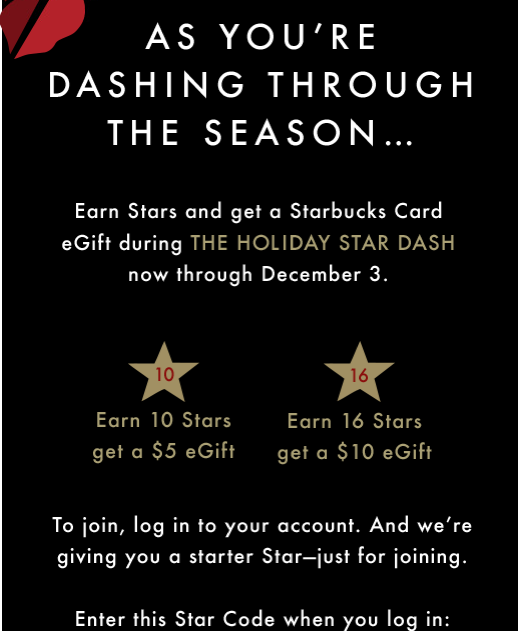
However, this is not the only mobile marketing program fail that occurred this morning. My lovely (and I mean lovely) wife received an email from Starbucks regarding the Holiday Star Dash.  The email requested that she click through the link and enter a 9-digit code on her Starbucks.com account page.  She popped open the mobile app hoping to find an easier way defined in “Messages.”  Nothing. Sigh.

Screen Shot 2013-11-21 at 1.18.18 PM

So why does this upset me so? Well, for one it’s clear that the online marketing and mobile marketing teams are not communicating.  I would imagine that the mobile marketing team is a separate group.  The mobile team should be an integral part of the overall marketing organization to avoid these kinds of consumer experience disconnects.  However, the biggest offense to me is that Starbucks has missed a huge opportunity to demonstrate how mobile can drive engagement and loyalty through incentives.

Several articles have been written about the challenges of driving mobile adoption and engagement…specifically in the mobile payments space.  Imagine if Starbucks focused the “buy 5 holiday beverages” program on the mobile audience by guiding people to pay with their mobile phone?  Or enabled Holiday Star Dash activation through the mobile app?  Engagement and redemption metrics would increase…and the lifetime value of these customers would increase.

By enabling online and mobile app participation, Starbucks will be able to compare the ROI across both channels.  It would not be a stretch of the imagination to guess redemption rates will be higher for mobile and that the life time value of the mobile user would increase with the right incentives. The most interesting metric would be the lifetime value of  users who pay for their Starbucks items using their mobile device. Starbucks has the opportunity to show real leadership in how mobile payments can help drive revenue.


Will the real mobile wallet please stand up? Please stand up.

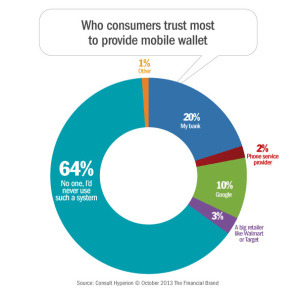
A recent study by Consult Hyperion found that over 64% of US consumers say that they would never use a mobile wallet.  Additionally, consumers were asked whom they would trust most to issue a mobile wallet.  The most trusted issuers were (in rank order):  banks at 20%, Google at 10%, major retailers at 3% and phone service providers at 2%.

American Consumers Dubious About Mobile Wallets

What intrigued me most was the statement of a Hyperion consultant who was offering an interpretation of the data:

“The study shows that issuers of mobile wallets need to do a better job conveying what mobile wallets really are and what benefits they bring,” says Dave Birch, a spokesperson for Consult Hyperion.

I think more effectively conveying the benefits of a mobile wallet is only a small part of the challenge. Agreed, the definition of a mobile wallet is not clear. Nodding to Eminem, will the real mobile wallet please stand up. Please stand up.

Does a mobile wallet enable P2P payments only?  Or can a user apply a credit card number to make a purchase through the wallet?  To make the definition even more confusing, does the mobile wallet include the myriad of loyalty cards as well?  If so, does Apple’s Passbook qualify as a wallet?  What about the lucky penny I carry in my wallet?  Can this penny, and the luck it has, be transferred to my mobile wallet? The Leprechaun lobby will have something to say about this.  They may be short, but they articulate a very clear point of view.

The biggest challenge facing increasing adoption of mobile wallets is the industry itself and the many different wallet technology providers available.  At this time, the mobile wallet industry is very fragmented and no clear leader has emerged.   There is no widely adopted wallet technology that a consumer can try to ease into this new payment tool.  Until this happens, consumers will be afraid to engage for fear of their financial data being compromised.

A similar problem plagued consumers around the concept of buying a vehicle site unseen through the Internet. I remember a friend who I thought was just insane for buying an Acura MDX off of eBay Motors from a guy in Phoenix.  eBay Motors has done a fantastic job in making the transaction process easy and safe. Now a vehicle sells every 60 seconds.  The mobile wallet vertical needs a leader like eBay to emerge to break ground into mass consumer adoption. Hmmm….maybe PayPal?

Now who will this leader be?  Based on the Hyperion study, it sounds like a bank could emerge as a leader.  From personal experience, I know banks are very slow to innovate…so I don’t think this will happen.  However, I think the provider of a mobile wallet platform that can connect to multiple banks’ online banking backend can emerge as a leader and industry standard setter.   Through the right strategic partnerships this technology provider can drive adoption fast before competitors can make “me too” solutions.

As I side note, I snickered at the Hyperion study data point that 10% of responders said they would trust Google to provide a mobile wallet.  Though small, this percentage I think can be accredited to brand advertising and marketing from Google.  The Google wallet technology is struggling and adoption on the merchant side is very low.  The power of marketing is very present in that statistic.


When can I buy more than coffee with my mobile device?

The concept of making a payment with a smart phone sounds very logical and conversationally appealing. We send text messages, share photos, check-in, buy things online and save travel itineraries with these devices.  So why not use it as a wallet too?  It would be great to have to carry one last thing in our pockets.

I think the CONCEPT of doing this makes sense to millions of consumers…but the reality is that it’s not happening as quickly as technology analysts or consumers predicted.  An eMarketer report predicts that mobile payments in the United States will cross the $1 billion threshold this year, which is a number far less than previously estimated.

This slower adoption rate reminds me of the slow broadband Internet adoption in the late 1990s.  I worked at Excite@Home and we promised to deliver high speed Internet access and robust content worthy of broadband to millions of homes and small businesses across the US.  I still have a t-shirt that says “broadband access, across all devices, all the time.” How cool was that promise!?  I expected to have this big pipe Internet connection into my home by the end of 2000.  What happened?

Similar to mobile payments, broadband Internet access was thwarted by multiple providers, convoluted access points and technologies.  It took a while for the cable networks to decouple from Excite@Home and offer broadband themselves.  DSL Internet providers slowly gained momentum to provide similar services, but not without a fight with telephony providers who controlled the coveted “last mile.”

Many of these technical and business challenges are faced by the mobile payments industry. A single mobile payment system has yet to emerge as a clear leader for consumers.  Making things more complex, no mobile payments system has emerged as a solution for small business to accept mobile payments.   With such confusion, business owners will be reluctant replace their POS card readers with a slick payment system that runs on an iPad.  Investors will also continue to be cautious as indicated by Capital One pulling out of its investment in Isis.

So, what to do?  Consumers and small businesses will need to take a wait and see approach.  Consumers will continue to make payments using a credit card, debit card or cash. But until a provider can develop a payments system easily adopted by small businesses, consumers will stick to only making mobile payments to buy their Starbucks coffee.